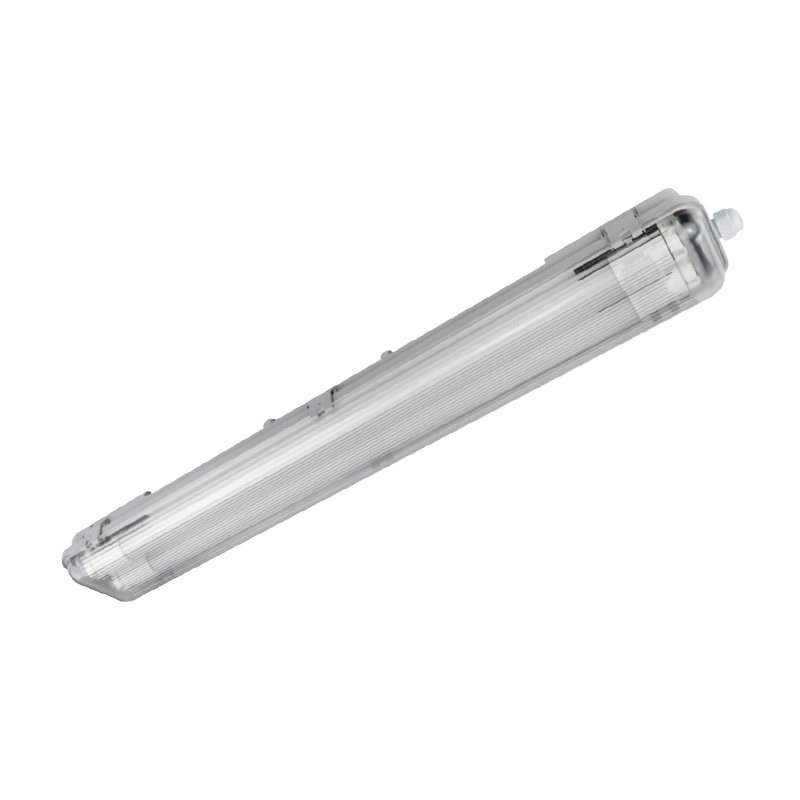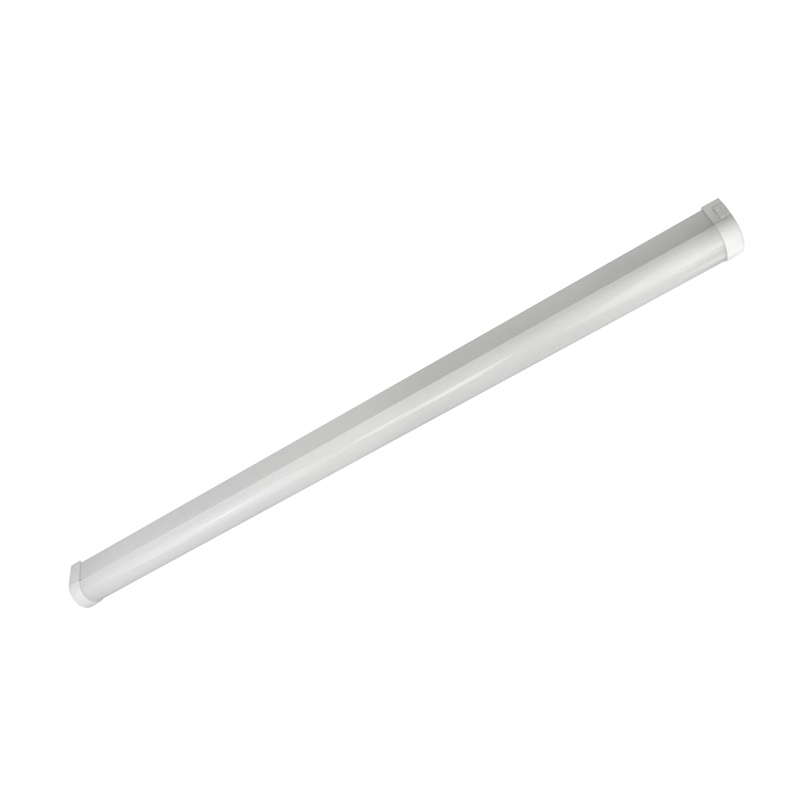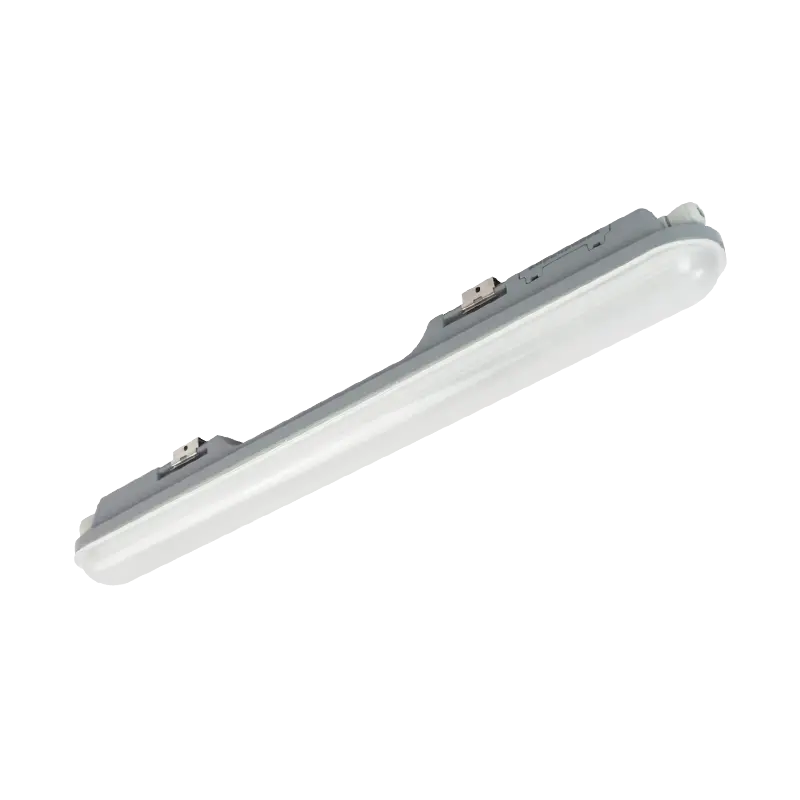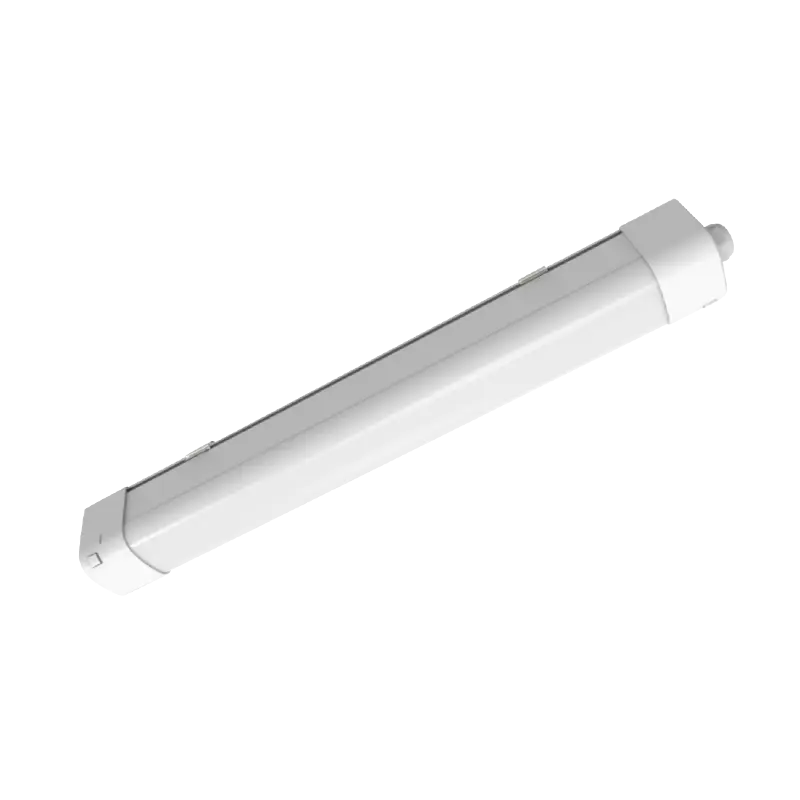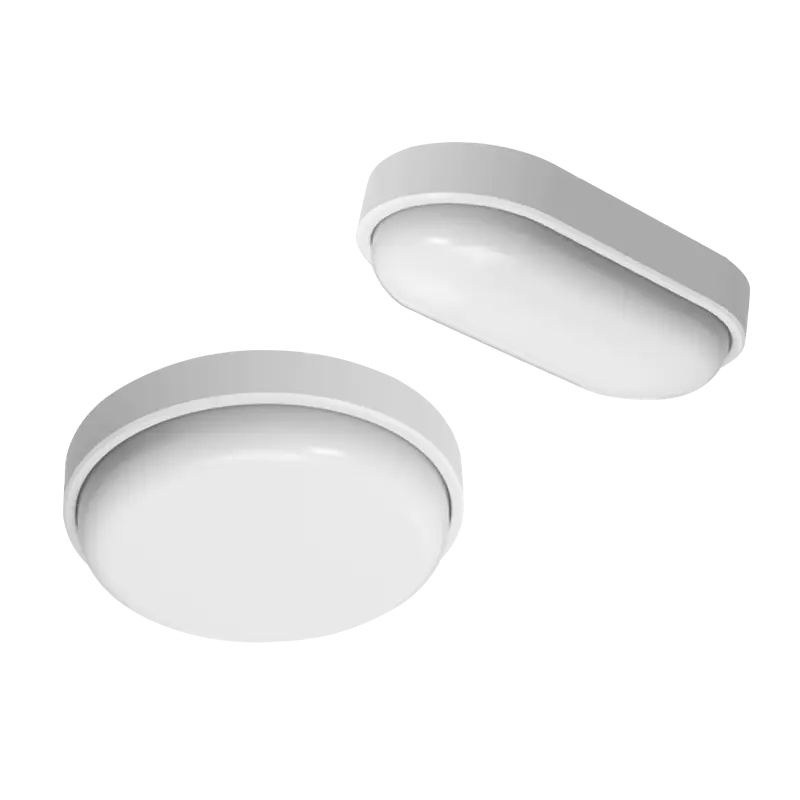


An LED tri-proof light can be installed outdoors and in car parks — but the enclosure, not the product name, decides whether it survives there. A fixture rated IP65 or IP66, built with a UV-stabilised polycarbonate diffuser, stainless-steel clips and a corrosion-resistant body, will run for years on a canopy soffit or an open parking deck. A lookalike fixture with an IP44 gasket, nickel-plated steel clips and unsealed cable entries will show water staining inside the diffuser within two wet seasons.
We have tracked the same 5-foot tri-proof housing through two very different installations. Under a coastal bus shelter with C4 corrosivity and daily washdown, the units passed nine years with only lens cleaning. On a rooftop car deck 40 kilometres inland, a visually identical batch failed in fourteen months — not because of the LED chip, but because the mounting angle let water pool on the gasket line and the cable gland pointed upward.
The answer to the question is therefore conditional. Four conditions have to hold at once.
IP65 as an absolute floor, IP66 preferred where wind-driven rain hits the fixture face at speed. Gasket compression must survive thermal cycling from -20 °C to +45 °C.
The body, clips and fasteners must match the site's ISO 9223 category. Coastal and de-icing-salt sites push ordinary painted steel past its limit.
Light has to land on the driving surface, not in a driver's eyes. Wide asymmetric distribution plus a controlled cut-off matters more outdoors than indoors.
Wind uplift, structural vibration from traffic decks, and drainage direction are installation issues that no IP rating can rescue after the fact.
Everything below works through those four conditions in the order a project actually meets them: standard definitions, then exposure zones, then photometrics, then installation and life-cycle maths.
Tri-proof is a trade category, not a single numbered standard. In practice it means the luminaire is designed against three intrusion paths: water, dust and corrosion. The formal anchors behind those three words are separate documents — IEC 60529 for ingress protection, IEC 62262 for impact, and ISO 9223 for atmospheric corrosivity. A datasheet that says "tri-proof" without a number is telling you the design intent and nothing about the verified performance.
When a supplier states IP65 and IK08, they are claiming two testable things: dust-tight construction with protection against water jets, and resistance to a 5-joule impact. When they state IP65 only, impact resistance is undefined and a stone thrown from a lawn mower or a trolley strike on a low-mounted fixture becomes an open risk.
Each of those five needs its own line in the specification. A car park project that copies an indoor warehouse specification and adds the word "outdoor" to the title is the single most common source of premature failure we see in tender reviews.
Rule of thumb for buyers: if the datasheet lists IP65 but no corrosion category, no IK rating, no ambient temperature range and no surge figure, treat the product as an indoor fixture with a better-than-average gasket.
The first digit is solids, the second is water. For an outdoor luminaire the second digit does almost all the work, because dust ingress alone rarely kills a fixture — moisture arriving with that dust does. The table below maps the ratings you will actually see quoted against where they belong in a parking structure.
| Rating | Test condition | Typical failure mode outdoors | Acceptable location |
|---|---|---|---|
| IP44 | Solids over 1 mm; splashing water from any direction | Water tracking along the diffuser lip, gasket hardening within 18 months | Indoor stair core only; not acceptable on any open deck |
| IP54 | Dust protected; splashing water | Dust film inside the lens, condensation rings on the diffuser | Fully enclosed, heated lobby areas |
| IP65 | Dust tight; water jets at 12.5 L/min from a 6.3 mm nozzle | Jet ingress through an incorrectly oriented cable gland | Covered canopy, soffit, underside of a ramp |
| IP66 | Dust tight; powerful jets at 100 L/min from a 12.5 mm nozzle | Almost none if glands are correct; gasket compression is the weak point | Open top deck, exposed ramp edge, coastal canopy |
| IP67 | Dust tight; temporary immersion to 1 m for 30 minutes | Water trapped inside the housing after a flood event, slow internal corrosion | Low-level deck edges, flood-prone basement ramps |
| IP69K | Dust tight; high-pressure, high-temperature jet wash | Over-specification cost with no added benefit unless washdown exists | Vehicle wash bays adjacent to the parking structure |
Two practical notes sit behind that table. First, IP66 and IP67 are not interchangeable in a car park. A fixture that survives immersion but traps water inside the housing will corrode its own driver compartment, while a jet-rated fixture with a breather membrane lets vapour escape. Second, IPX9K is a washdown rating; specifying it for a general parking deck adds cost and usually forces a heavier housing with worse thermal behaviour.
Suppliers sometimes quote compound ratings such as IP65/IP67, or quote a rating measured on a bare luminaire while the installed version has a sensor module cut into the diffuser. Both deserve scrutiny.
Level 5 means dust protected — limited ingress that does not interfere with operation. Level 6 means dust tight, no ingress at all. Every outdoor car park fixture should sit at 6. A level 5 fixture will accumulate a fine film over a few summers, and that film becomes the condensation nucleus that fogs the diffuser from the inside.
Level 5 covers jets at 12.5 litres per minute from 6.3 mm nozzles. Level 6 raises the flow to 100 litres per minute through 12.5 mm nozzles. Level 7 adds 30 minutes at one metre of immersion. Level 9K uses 80 °C water at 80–100 bar from close range. The jump from 5 to 6 is the one that matters for exposed decks, because wind-driven rain behaves far closer to a powerful jet than to a gentle splash.
Microwave sensors, photocells and emergency indicator windows all create additional sealing interfaces. If a datasheet quotes IP66 for the base body but the delivered unit includes a sensor lens, ask for the rating of the assembled configuration. We have seen projects where the base body held IP66 and the sensor cut-out held nothing at all, allowing water to run directly onto the driver.
Water ingress shows up quickly and gets fixed. Corrosion works slowly and quietly, then turns a maintenance job into a replacement programme. ISO 9223 defines six atmospheric categories; the ones that matter for exterior lighting are C3, C4 and C5.
A car park falls into C4 more often than owners expect, because the salt arrives on vehicle undersides rather than from the sea. In a northern European or North American winter city, the deck surface carries a continuous salt film and the air directly above it is a fine aerosol for four months a year.
The housing is rarely the first casualty. The order of failure is usually: clips, then screws, then the mounting bracket, then the end caps, and finally the body coating.
Nickel-plated steel clips on a stainless budget become the first failure point. Specify 304 stainless for C3 and 316 for C4 and C5 sites.
Mixed metals create galvanic couples. A stainless screw into an aluminium extrusion in a wet environment will show pitting at the thread within two years.
Powder coating below 60 µm on a C4 site is decoration, not protection. Pre-treated aluminium with 80 µm or a chromate-free conversion layer holds up far better.
Trapped moisture attacks the driver case and the PCB edge. A breather membrane that equalises pressure without admitting liquid water prevents most of it.
Corrosion class is also a warranty argument. If a supplier offers a five-year warranty on the body but only lists a one-year warranty on clips and fasteners, the small print has already told you which parts they expect to fail.
A parking structure is not one environment. Treating it as a single specification is how projects end up over-spending on the stair core and under-spending on the deck.
Rain rarely reaches the fixture face directly, so IP65 is workable. The dominant stress is vehicle exhaust, dust and occasional pressure washing of the slab. Choose a smooth, non-porous diffuser so cleaning does not abrade it.
The highest-stress zone. Daytime adaptation requires far higher illuminance than the deck itself, and the fixtures are usually surface mounted where splash from wet tyres reaches them. IP66 plus IK08 plus a housing designed to shed water.
Full rain, wind-driven spray, direct sun and UV. IP66, UV-stabilised polycarbonate, corrosion category C4 minimum, and thermal design that expects a 50 °C ambient in summer sun.
Technically indoor. A standard IP20 or IP44 fixture is usually the correct and cheaper answer; specifying a sealed tri-proof body here adds cost and can reduce light output by trapping heat.
The staircase deserves one extra note: these areas often carry the emergency lighting circuit, and the fixture selected for the stair core will need a battery pack or a central battery feed. Mixing a tri-proof emergency body into an indoor stair core is a common compromise in retrofit projects, and it works, provided the thermal design allows for the battery's own heat.
Wind load on a linear tri-proof fixture is not trivial. A 1.5-metre, 60 mm wide body presents roughly 0.09 m² of surface; in a 40 m/s gust that translates into a meaningful point load at each bracket, and if the bracket spacing is 1.2 metres, the anchor at each end carries the entire span moment.
Three installation decisions dominate:
Chain or rod suspension is common under concrete soffits. Check that the suspension point is rated for the fixture weight plus a safety factor, and that the cable entry stays above the fixture body. A gland pointing upward is an open invitation for water.
On exposed decks, always mount the cable entry on the underside or the low end of a sloped body. It is the single cheapest reliability improvement available, and it costs nothing at installation time.
Outdoor installations swing through a far wider temperature band than warehouses. A car park deck in a continental climate can see -25 °C on a January night and 55 °C on a black asphalt surface in July. The luminaire is a sealed box in both cases.
Heat matters because LED efficacy and driver life both fall as junction temperature rises. A sealed polycarbonate body with no external fins behaves very differently in still air at 45 °C than in a ventilated factory at 25 °C. Ask for the lumen output at 45 °C ambient rather than the 25 °C laboratory figure, because the difference on a summer deck is typically 8 to 12 percent.
Cold matters for two reasons. Standard drivers have a lower operating limit, often -20 °C or -25 °C, and electrolytic capacitors age faster in cold-cycling conditions. Emergency battery packs are worse: many lithium packs lose usable capacity below -10 °C, which is exactly when a winter power failure happens.
A sealed housing is not a dry housing. Air trapped at assembly carries moisture, and each thermal cycle pumps a little more vapour through imperfect seals. The vapour condenses on the coldest surface, usually the diffuser at dawn, then runs down onto the driver.
Three countermeasures work: a pressure-equalising breather membrane, a desiccant pack in the driver compartment, and a housing geometry that lets condensate collect away from electronics. We cover the mechanism and the design responses in more detail in our article on preventing internal condensation in tri-proof lamps.
Tri-proof fixtures were designed for factories, where a broad, even wash of light is exactly what the task needs. A car park has a different task: a driver moving at 15 to 25 km/h needs to read surfaces, detect pedestrians and identify bays, without being blinded by a fixture mounted at 3 metres.
Reference values from EN 12464-1 for indoor car parks give a useful starting point for outdoor decks as well.
| Area | Maintained illuminance | Uniformity (Uo) | Additional requirement |
|---|---|---|---|
| Traffic lanes | 75 lux | 0.40 | Continuous, no dark gaps between fixtures |
| Parking bays | 75 lux | 0.25 | Vertical illuminance at 1.5 m for face recognition in CCTV zones |
| Ramps, day | 300 lux at the threshold, tapering inward | 0.40 | Adaptation control; the transition zone is more important than the level |
| Ramps, night | 75 to 100 lux | 0.40 | Control cut-off to avoid glare into adjacent residential windows |
| Pedestrian routes | 50 lux | 0.25 | Higher vertical component than vehicle lanes |
| Entrance and pay station | 200 lux | 0.40 | Reduced flicker for camera systems, under 1 percent modulation depth |
A standard 120° beam tri-proof fixture mounted at 3 metres on a low ceiling sends light sideways as well as downward. At the driver's eye height of 1.2 metres, that sideways component is direct glare. The visible result is a bright stripe on the ceiling and a darker patch on the floor — the opposite of what the layout drawing promised.
Three fixes exist, in order of cost:
For car park work, the practical target is a luminaire luminance below about 10,000 cd/m² at 55° and above, combined with a UGR of 22 or lower where the fixture sits within the driver's forward field of view.
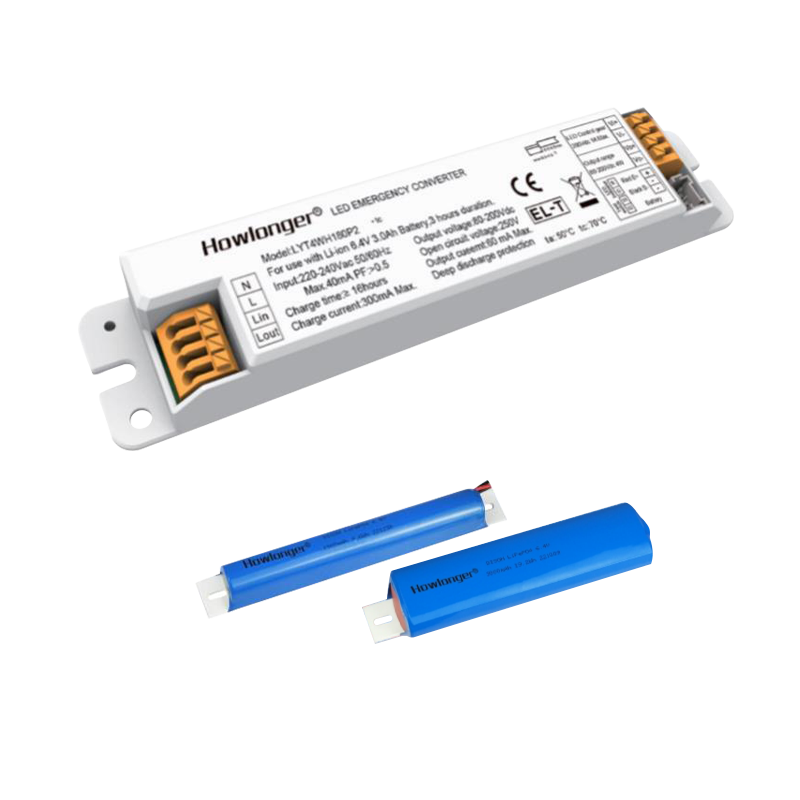
Emergency lighting is where outdoor car park specifications most often fall apart. The fixture that meets IP66 in normal operation may not meet it once a battery pack and an indicator window are added.
Points that decide whether an emergency tri-proof fixture is genuinely fit for a deck:
Where the structure has a central emergency supply, a self-contained pack is the wrong choice and adds a maintenance liability. Where it does not, a self-contained fixture with a monitored, replaceable pack is far more practical than a retrofit kit installed later.
Most outdoor tri-proof failures we investigate are installation faults, not product faults. The list below is worth turning into a site checklist.
The capital cost gap between a fluorescent batten and a tri-proof LED has narrowed to the point where the decision is usually about maintenance access rather than purchase price. The chart below shows relative ten-year cost for a 200-fixture car park deck, normalised to a fluorescent baseline of 100.
The gap between the second and third bar is almost entirely surge protection and driver quality. On a long outdoor circuit with inductive loads and nearby lightning activity, a basic driver without a 10 kV surge module is the highest-frequency replacement item in the whole installation. The gap between the third and fourth bar is occupancy and daylight dimming, which is where most of the remaining savings sit in a car park that is only partly occupied overnight.
| Cost element | Economy fixture | Car-park-grade fixture |
|---|---|---|
| Purchase price per unit | Baseline | 25 to 45 percent higher |
| Driver replacement rate | One in five units within five years | Under one in twenty |
| Gasket and clip replacement | Required at three to four years | Not required within ten years at C3 |
| Cleaning frequency | Higher, because dust film forms inside the lens | Lower, sealed enclosure stays clear |
| Access cost for replacement | Scaffold or MEWP each time | Amortised over a longer cycle |
The access cost is the line that surprises facility managers. In a multi-storey structure, one lift of a mobile platform to reach a ceiling fixture often costs more than the fixture itself, which means the cheapest unit is rarely the cheapest installation.
Our own range splits along the two axes that matter for these sites: body construction and light distribution. The aluminium-bodied package range gives the thermal headroom that exposed decks need, while the tube-based range suits retrofits where existing T8 battens are being replaced without changing the ceiling grid. The full family is listed under LED tri-proof lights.
LG06J uses an aluminium alloy body with a 120° beam and a sealed diffuser, which makes it a reasonable starting point for covered canopies and structural soffits where heat build-up is the limiting factor rather than wind-driven rain.
 LG06J Aluminium Alloy IP65 LED Tri-Proof LightIP65 aluminium alloy tri-proof light with 120° beam and replaceable source, suited to covered canopies and soffits where heat build-up is the main constraint.View Product →
LG07O is a T8-format, workshop-oriented low-energy tube tri-proof fixture. It suits conversion projects in indoor or semi-enclosed parking levels where the existing batten spacing is being kept and only the luminaire is changing.
LG07O T8 Low-Energy Tube Tri-Proof LightT8 tri-proof fixture for workshops and retrofit projects, available in single or double tube versions with IP65 protection and flexible lamp holders.View Product →
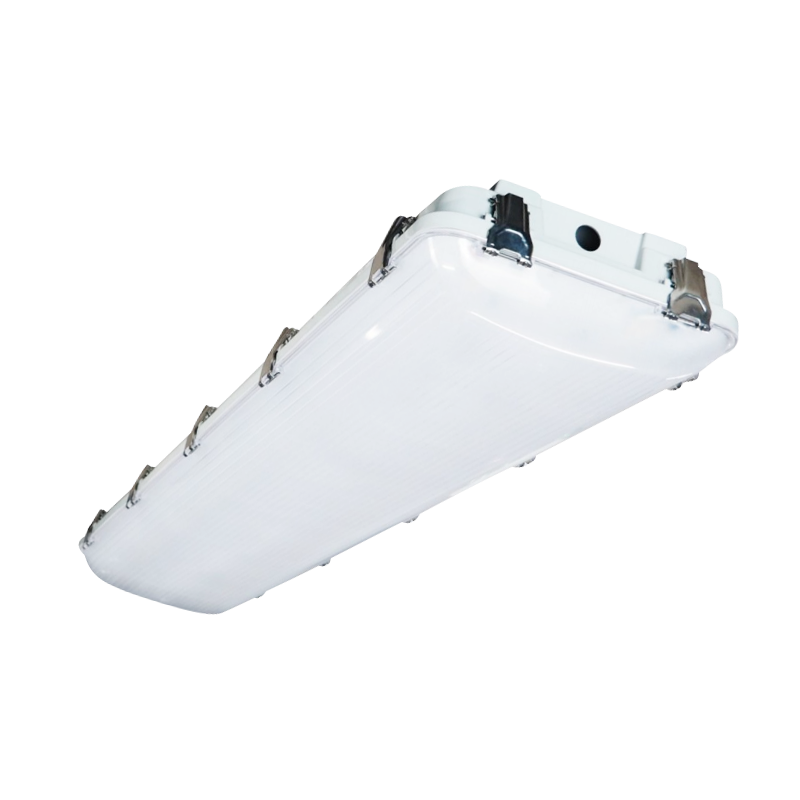
LG21A sits in our North American vapor-tight series, built for the connector and voltage conventions used on that continent, and is typically specified for exposed decks and ramps where a sealed, serviceable body with straightforward field wiring is the priority.
 LG21A Multi-Power LED Vapor Tight FixtureNorth American vapor-tight fixture with metal locking clips, multi-power models and AC120–347V input for exposed decks, ramps and serviceable field wiring.View Product →
No. A tri-proof light is designed against water, dust and corrosion, but only the quoted IP and corrosion figures tell you how far that design goes. Anything below IP65 should stay under a roof, and anything without a stated corrosion category should be assumed suitable for C2 sites only.
Usually not. IP65 protects against jets at 12.5 litres per minute, which is less than wind-driven rain delivers on an exposed deck. IP66 is the more defensible minimum for any fixture facing open sky, especially where the ceiling is a soffit that funnels water sideways.
Rarely. IP67 helps on low-level deck edges and flood-prone basement ramps where standing water is realistic. IP69K only makes sense next to a vehicle wash bay. Both add cost and often reduce thermal performance.
The light output will be fine; the driver and any battery pack are the limits. Check the driver's rated ambient range on the datasheet rather than the luminaire's marketing range, and check the emergency pack's discharge performance separately.
Moisture trapped at assembly condenses on the coldest surface during each thermal cycle. A pressure-equalising breather membrane and a desiccant pack solve most cases; simply sealing the housing harder usually makes it worse, because the trapped air has nowhere to go.
It depends on mounting height and optic. A practical starting point for a 3-metre mounting height with a 120° beam is a spacing-to-height ratio of about 1.2 to 1.4, then verified by a lighting calculation that checks uniformity, not just average illuminance.
Only with attention to vertical illuminance and flicker. Cameras need light on faces at 1.5 metres, not just on the floor, and drivers with poor ripple performance can produce banding in video feeds. Specify vertical illuminance and a modulation depth below 1 percent in those areas.
Usually not. Stair cores are indoor environments and a standard IP20 or IP44 fixture is cheaper, easier to maintain and better thermally. The one exception is where the stair core is genuinely open to the weather.
Look for the split. A five-year body warranty alongside a one-year clip and driver warranty tells you where the supplier expects failures. A defensible car park specification usually carries five years across body, driver and coating, with the corrosion category stated in writing.
It is the highest-return upgrade on a long outdoor circuit. A 10 kV surge module costs a small fraction of one service visit, and driver failure from transient overvoltage is the single most common reason outdoor LED fixtures are replaced early.
Use the list below as a filter at quotation stage, not at commissioning. Each line corresponds to a failure mode that cannot be corrected after installation.
If a supplier can answer all eleven points in writing, the fixture is likely to survive an outdoor car park. If three or four answers are missing, the installation will still light up on day one — and that is precisely the problem, because the failure will arrive after the project has been signed off.



No.8, Ankang West Road, Zonghan Street, Cixi City, Zhejiang Province, P.R.China
0086-574-6320 0283
Copyright © Ningbo Longer Lighting Co., Ltd.
All Rights Reserved.
 Wholesale LED Lighting Fixtures Manufacturers

 Deutsch