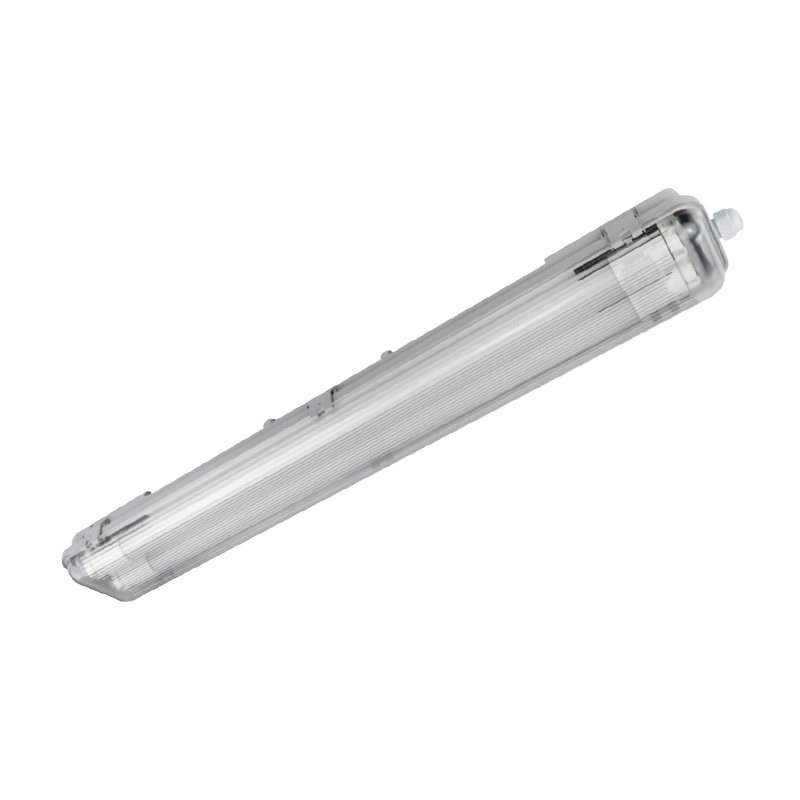


Start with the connected load, not the tube label. A standard 4-foot fluorescent batten using a 36 W tube and a magnetic or electronic ballast often draws 42 W to 48 W at the socket. A comparable LED batten usually runs at 18 W to 24 W for the same linear lighting task. At 4,000 operating hours per year, that difference is roughly 70 kWh to 110 kWh per fixture. Across 200 fixtures, the gap reaches 14,000 kWh to 22,000 kWh before any sensor or dimming savings are counted.
Illustrative values only. Use the fixture label, driver datasheet and a watt meter for the actual connected load.
The conclusion is simple enough for a budget meeting: in dry indoor areas with long operating hours, an integrated LED batten is usually the lower-cost choice over five years. The decision becomes more nuanced when the existing fixture is difficult to access, the area is wet or dusty, the circuit has old switches, or the building needs dimming and occupancy control. Those conditions change the labor and risk side of the equation more than the LED chip itself.
A 20 W LED batten is not automatically a replacement for a 40 W fluorescent batten. The useful comparison is delivered lumens after optical and thermal losses, not the number printed on the tube. Fluorescent systems also carry ballast losses, and their light output falls in cold rooms or poorly ventilated fixtures. LED systems can hold output better, but only when the driver and heat path are designed for the enclosure.
Use three numbers when comparing proposals:
Fluorescent battens often have a ballast factor of 0.85 to 1.00, and magnetic ballasts add more losses than electronic types. An old fixture may also have a failing lamp or a ballast that consumes power while producing little useful light. LED battens have their own variables: driver efficiency, standby power, dimming losses and the current setting at the factory. Two products with the same 20 W nominal rating can differ by 10% to 20% in delivered light and by several years in driver life.
For each existing fixture, record the tube wattage, ballast type, measured input watts and annual operating hours. Then record the proposed LED batten’s input watts, delivered lumens and control strategy. If the existing installation is over-lit, do not replace 46 W with 46 W of LED and call it efficiency. Right-size the light level first, then apply the LED efficacy gain. That sequence usually produces a larger and more credible saving than a simple one-for-one wattage swap.
Assume a facility has 200 four-foot fluorescent battens, each drawing 46 W including ballast loss. They run 4,000 hours per year. The electricity tariff is 0.15 USD per kWh. The proposed LED batten draws 20 W and delivers comparable maintained light in the task area. The annual energy difference is 26 W per fixture, or 20,800 kWh for the site. At 0.15 USD per kWh, the annual saving is 3,120 USD.
| Item | Fluorescent baseline | LED batten replacement | Difference |
|---|---|---|---|
| Connected power per fixture | 46 W | 20 W | 26 W lower |
| Annual energy use | 36,800 kWh | 16,000 kWh | 20,800 kWh lower |
| Annual energy cost | 5,520 USD | 2,400 USD | 3,120 USD lower |
| Five-year energy cost | 27,600 USD | 12,000 USD | 15,600 USD lower |
| Typical relamp or maintenance events | Higher frequency | Lower frequency | Labor and access savings vary |
A common mistake is to divide the LED batten price by the annual energy saving and ignore installation. If a full fitting costs 45 USD and takes 20 minutes to install, the labor cost may be as important as the product cost. A tube retrofit may look cheaper on paper, but if it requires removing a ballast, rewiring sockets and verifying compatibility, the installed cost can approach a complete fitting replacement. The cleaner calculation is total installed cost divided by first-year energy and maintenance savings.
For a quick estimate, use this formula: Simple payback in years = total installed cost / (annual kWh saved × tariff + annual maintenance avoided). If the result is under three years for a long-hour site, the project usually deserves a detailed quotation. If it is over six years, check whether the existing fixtures are over-lit, whether controls can reduce hours, or whether a lower-cost retrofit is technically acceptable.
Warehouses, cold stores and production halls that run around the clock see a larger absolute saving because the operating hours are high. Sites with demand charges may also reduce peak load, although lighting is often a modest part of the total demand. The more reliable benefit is kWh reduction. For 24/7 operation, 8,760 hours per year is the maximum; use the actual schedule, including weekend setback and holiday shutdowns, rather than a nominal figure.
An LED batten can be efficient on a datasheet and still disappoint in a building. The common causes are predictable, and most are visible before purchase.
Some LED tube retrofits are designed to work with an existing ballast. That can be convenient, but it preserves an aging component and adds losses. A ballast-compatible LED tube may also have a narrower operating window, and mixed ballast types on one floor make maintenance confusing. For a planned upgrade, a direct-wire LED batten or a ballast-bypass retrofit removes that failure point.
A cheap 15 W LED batten with a low-efficacy diffuser may produce less useful light than a 24 W unit with a better optical design. If the installation ends up with more fixtures to compensate, the energy saving erodes. Compare lumens, beam distribution and spacing, not only input power.
The driver is often the first component to fail in a low-cost fixture. A driver run near its maximum temperature will age faster, especially in an insulated ceiling or a warm production hall. Ask for the driver’s rated ambient temperature, the fixture’s thermal test data and the warranty terms. A product that claims 50,000 hours while using a driver rated for a lower case temperature deserves a closer question.
Replacing a 46 W fluorescent fixture with a 40 W LED fixture is not an energy project. It is a like-for-like relamp with a smaller saving. A lighting layout should confirm the required lux level for the task, then select the lowest wattage that meets it with acceptable uniformity. In storage aisles, task lighting at rack faces may be more useful than flooding the entire ceiling.
High efficacy is not only a chip specification; it is a system result. A well-designed diffuser, a driver running below its thermal limit and a housing that moves heat away from the LEDs all affect delivered lumens per watt. The principles in this high-efficacy LED batten design article apply directly to retrofit planning.
The right answer depends on the condition of the existing fixture and the cost of access. A tube retrofit keeps the old housing. A complete LED batten replaces the housing, socket, wiring and optical system as one product. For a single office with two failed tubes, the retrofit may be sensible. For a production hall with 300 fixtures and scaffolding costs, the complete fitting is often the more predictable purchase.
| Option | Best for | Main advantage | Main risk |
|---|---|---|---|
| Ballast-compatible LED tube | Small replacements where the existing ballast is known to be compatible | Fast swap and low initial material cost | Old ballast remains, compatibility varies, future maintenance is uncertain |
| Ballast-bypass LED tube | Fixtures in good condition with accessible wiring | Removes ballast losses and simplifies the circuit | Requires rewiring and a qualified electrician; labeling is essential |
| Complete LED batten fitting | Planned upgrades, high ceilings, wet or dusty areas, control projects | New driver, optics, housing and warranty in one system | Higher material cost and possible mounting modifications |
| New LED batten with sensor or dimming | Warehouses, car parks, stairwells and intermittent-use areas | Adds hours-based savings and better zone control | Commissioning and compatibility checks are required |
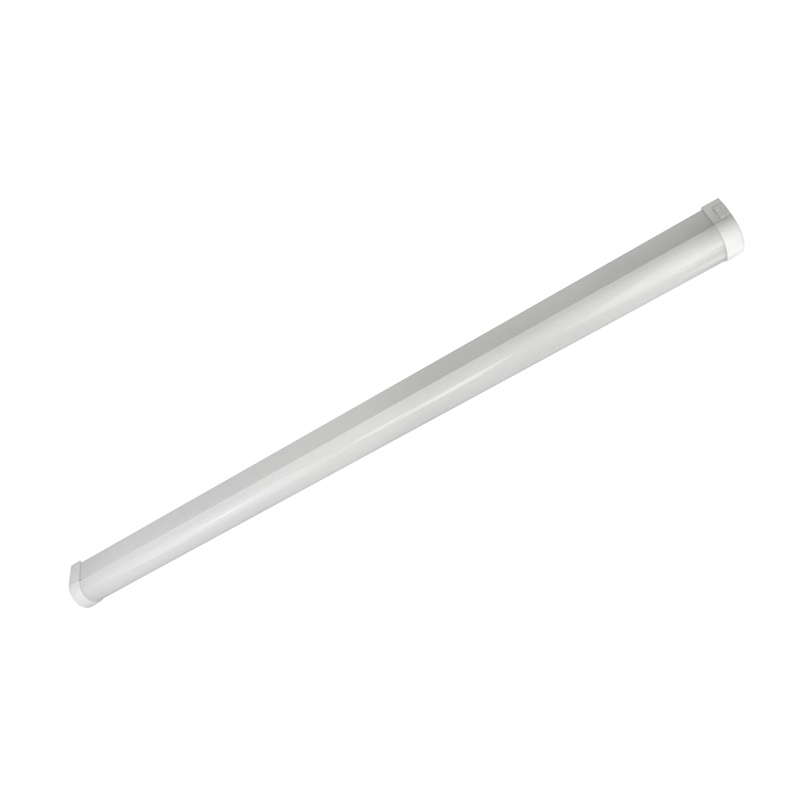
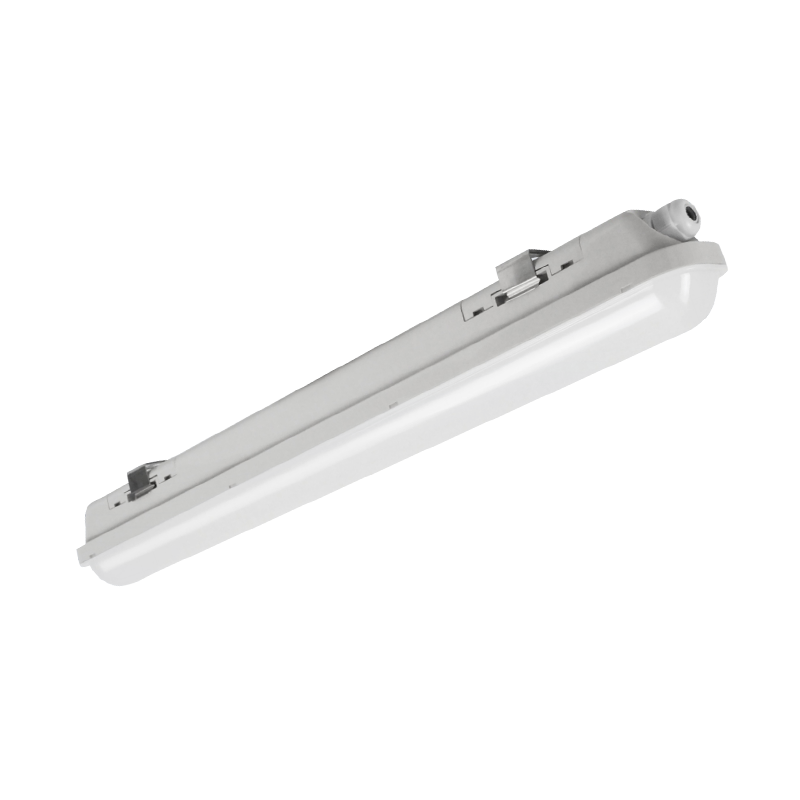
For a full replacement in a clean indoor area, the LG15D is a slim batten fitting with a 120 degree beam angle and IP20 rating. It suits linear runs where the ceiling is dry and the main requirement is even light at a low profile. Check the mounting centers, cable entry and end-cap clearance against the existing batten before ordering. The IP20 rating is an indoor-dry designation, so it is not the right choice for washdown, open canopies or heavy condensation.
 LG15D Slim LED Batten Fitting with 120° BeamA slim IP20 LED batten for dry indoor linear runs, offering multiple lengths, wattages and CCTs; check mounting centers and clearance before ordering.View Product →
A tube retrofit can be a reasonable interim step when the housing is in good condition, the ballast is compatible and the site cannot accept a full shutdown. The decision should be documented: ballast type, LED tube model, compatibility list, rewiring method and a label inside the fixture. Mixed retrofits across a floor create inspection and maintenance problems later. If the site already has flickering tubes, yellowed diffusers or cracked end caps, the housing is telling you that a complete fitting is the better lifecycle choice.
Most failed LED batten projects are not caused by LED technology. They are caused by a mismatch between the new fixture and the existing ceiling, circuit or control system. Run these checks before the purchase order is released.
Compare the existing layout with the proposed lumen output, beam angle and spacing. A 120 degree beam angle spreads light broadly, which is useful for general linear lighting but may not suit high racks or narrow aisles. Ask for a simple layout calculation for the actual mounting height and reflectance. If the proposal only lists wattage and color temperature, the lighting design is incomplete.
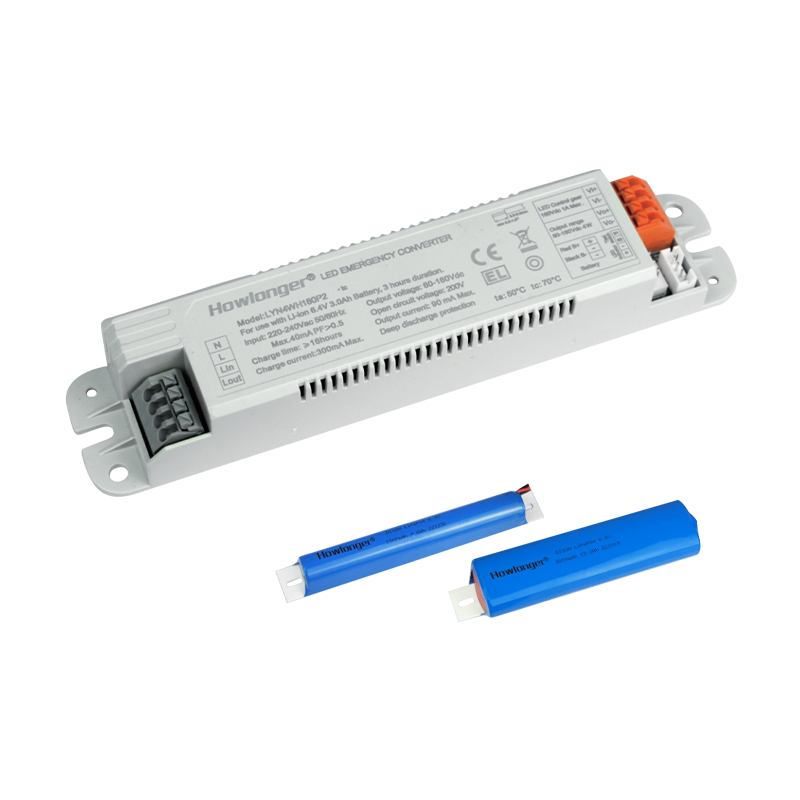
Dimming, microwave sensors, daylight harvesting and emergency packs all change the fixture specification. Confirm the control protocol, standby power, minimum dim level and emergency lumen output. For emergency lighting, the battery pack, charge circuit and test method must be part of the luminaire approval, not an afterthought added on site.
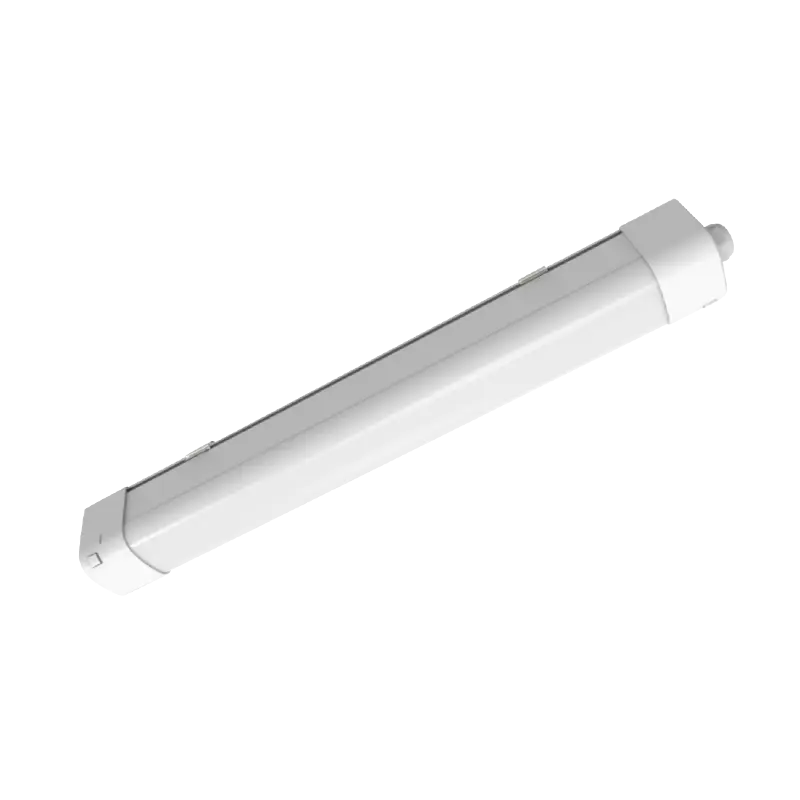
For general indoor linear lighting, the LG05BN series is one option to compare with the existing fixture layout. Do not choose it on model name alone; match length, wattage, lumen output and wiring method. A product card is only useful after the electrical and photometric checks are complete.
 LG05BN Slim LED Batten Fitting SeriesA slim indoor LED batten with ON/OFF switch and 90° or 180° mounting options; compare length, wattage, lumen output and wiring before selection.View Product →
A batten that saves energy but produces glare, flicker or poor color can cost more in productivity and complaints than it saves on the electricity bill. Fluorescent systems have their own issues, including flicker from magnetic ballasts, cold-start delay and mercury content. LED systems can be excellent, but low-cost drivers and poor diffusers can introduce visible flicker, especially with cameras or moving machinery.
| Parameter | Why it matters | What to request |
|---|---|---|
| Color consistency | Mixed color temperatures look untidy in open ceilings and retail areas | CCT, CRI and color tolerance within the same order |
| Flicker | Can affect video, rotating machinery, inspection tasks and user comfort | Flicker percent and frequency test data, not only “flicker-free” wording |
| Glare control | Bare linear lamps can be uncomfortable in offices and low ceilings | Diffuser type, UGR data where relevant and recommended mounting height |
| Ingress protection | IP20 is for dry indoor areas; wet or dusty sites need a sealed housing | IP rating, IK rating and ambient temperature range |
| Driver life | The driver often determines the practical service life | Driver ambient rating, warranty terms and replaceability |
Flicker is not always visible to the eye. A phone camera or a high-speed inspection camera can reveal modulation that looks acceptable in a showroom. Dimming systems can make it worse at low levels, and some sensors introduce a short pulse during switching. If the space has video conferencing, machine vision, rotating tools or fine assembly, ask for flicker data at several dim levels, not only at full output.
The LG15D’s IP20 rating is suitable for dry indoor linear lighting. It is not a washdown fixture. In food processing, open loading docks, cold stores with condensation or dusty workshops, a sealed tri-proof or vapor-tight product is the more appropriate category. The same logic applies to impact: a batten mounted low on a wall in a busy corridor needs a higher IK rating than a ceiling fixture in an office.
Lamp life claims are often quoted as a single number, but the useful metric is lumen maintenance. L70 means the fixture maintains at least 70% of its initial lumen output. A 50,000-hour L70 rating is not a promise that every unit will fail at 50,000 hours; it is a statistical statement about a population under specified conditions. Driver temperature, switching frequency, ambient humidity and supply quality all affect the real service life.
Fluorescent maintenance has a different cost profile. Tubes may need group relamping before they fail because output drops and color shifts. Ballasts can fail before the tubes. In high ceilings, the labor to access a fixture can exceed the cost of the tube. LED battens reduce relamping frequency, but they are not maintenance-free. Diffusers need cleaning in dusty sites, drivers may need replacement, and failed units should be replaced with the same model or a verified equivalent to keep color and output consistent.
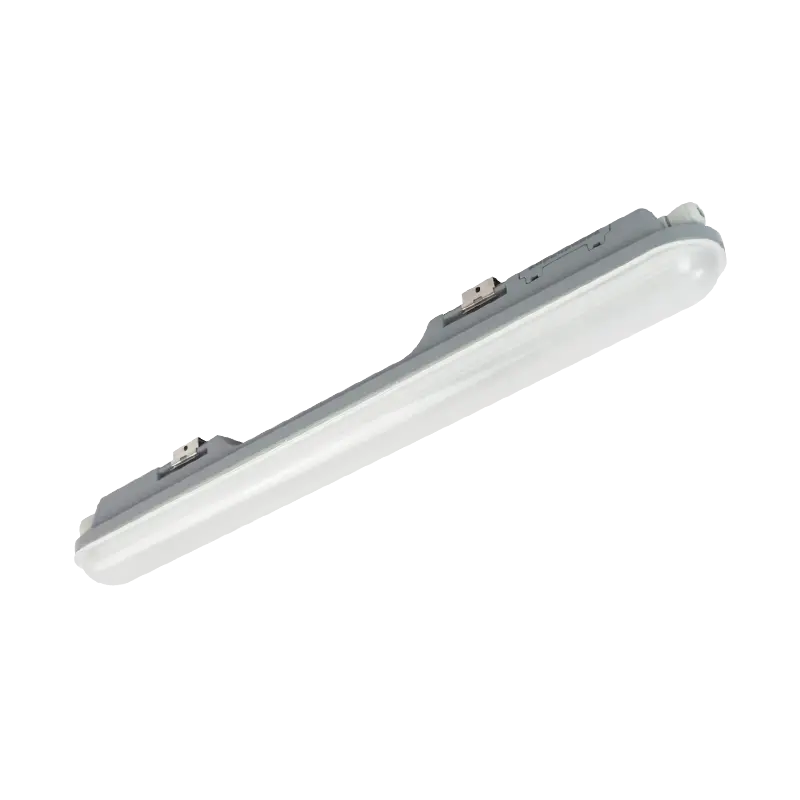
For projects that need a batten platform with several configurations, compare the LG12A route against a single fixed model. A family of products can simplify spares and future expansion, but only if the project team records the exact wattage, length and driver variant installed in each area.
LG12A LED Batten Fitting with Multiple ConfigurationsA configurable indoor LED batten family with UGR19 anti-glare, multiple lengths and wattages; useful where spares and future expansion require recorded variants.View Product →The same LED batten is not the right answer for every room. Use the application to set the enclosure, beam and control requirements before comparing prices.
Prioritize delivered lumens at the task plane, uniform spacing and a driver rated for the ambient temperature. In dry areas, an IP20 batten may be acceptable. In dusty or washdown zones, use a sealed tri-proof or vapor-tight fixture. Check high-bay mounting height and rack shadowing rather than assuming a linear batten will cover the aisle.
Look for low flicker, good color rendering and glare control at the workbench. A 120 degree beam can be comfortable in low ceilings but may spread light too widely in tall rooms. If workers rotate parts or use inspection cameras, test the proposed driver with the camera before full rollout.
Confirm the driver’s low-temperature starting performance and the fixture’s condensation resistance. IP20 is not enough for washdown or open cold-room ceilings with dripping water. A sealed housing and corrosion-resistant fixings matter more than a small wattage difference.
Use a diffused batten with controlled glare, consistent color and quiet operation. Flicker and color shift are more noticeable in customer-facing areas. If dimming is specified, confirm the complete driver and control compatibility, including the minimum dim level and standby power.
Check IP and IK ratings, sensor coverage and emergency lighting integration. Linear battens are often used for general circulation, while loading docks may need a more protected fixture at the door opening. Consider corrosion from road salt and humidity in coastal sites.
Long operating hours in shared areas make occupancy or daylight control attractive. Choose a driver that handles frequent switching and confirm emergency illuminance on the escape route. A slim batten can fit tight ceiling zones, but access for testing must remain possible.
A low unit price can hide batch inconsistency, weak packaging or a driver that is difficult to replace. For a multi-site rollout, the purchase order should include technical acceptance terms, not only quantity and delivery date.
Acceptance testing should include a burn-in period for a sample batch, a visual check for diffuser scratches and a functional check of any sensor or dimming option. On site, keep a lighting schedule with the exact model installed in each area. That record is more valuable than a generic O&M manual when a single fixture fails two years later.
No. A 50% saving is common for a complete LED batten replacing a 36 W tube plus ballast, but the actual result depends on the LED product, the existing ballast, the operating hours and whether the space was over-lit. A ballast-compatible LED tube may save less because the old ballast remains in circuit. Measure input watts before and after, or use the datasheet values for the exact configuration.
Only if the LED tube is explicitly listed as compatible with that ballast type and the manufacturer’s compatibility list includes the model. Even then, the ballast remains an aging component and adds losses. For a planned upgrade, a direct-wire LED batten or a ballast-bypass solution is usually cleaner. Local electrical rules and the fixture labeling requirements must be followed.
It can be, but check delivered lumens, beam distribution and mounting height. A 20 W LED batten at 2,600 lumens may replace a 40 W fluorescent system in a low-ceiling office, while a higher mounting height or a task with fine detail may need more light. Use a layout calculation rather than a wattage rule of thumb.
Common causes include an incompatible dimmer, a shared neutral or wiring fault, a driver at the low end of its dimming range, or a sensor that is switching the circuit too quickly. A ballast-compatible tube on the wrong ballast can also flicker. Test one fixture on a direct supply first, then add the control device and compare the result.
For a complete LED batten, the fixture is wired as a new luminaire, so the supply connection must match the terminal block and earthing requirements. For a tube retrofit, the answer depends on whether the product is ballast-compatible or ballast-bypass. Bypass retrofits require rewiring and clear labeling inside the fixture. A qualified electrician should confirm the method.
Use a batten in a dry, clean workshop with a normal ceiling. Use a tri-proof or vapor-tight fixture where there is dust, moisture, washdown, condensation or a risk of water spray. The light quality can be similar, but the enclosure and driver protection are different. Do not use an IP20 batten in a washdown area just because it has a higher lumen output.
Subtract the LED connected wattage from the existing fluorescent connected wattage. Multiply by annual operating hours and the number of fixtures, then divide by 1,000 to get annual kWh saved. Multiply by the tariff and add any maintenance avoided. Divide the total installed cost by that annual saving. Use actual hours and a realistic installation quote.
Ask for a written warranty that covers the complete luminaire, including the driver, and states the operating conditions. A five-year warranty is common for quality commercial products, but the value depends on the exclusions, the failure process and the availability of spares. For critical areas, ask whether spare drivers or matching fixtures can be held in stock.



No.8, Ankang West Road, Zonghan Street, Cixi City, Zhejiang Province, P.R.China
0086-574-6320 0283
Copyright © Ningbo Longer Lighting Co., Ltd.
All Rights Reserved.
 Wholesale LED Lighting Fixtures Manufacturers

 Deutsch