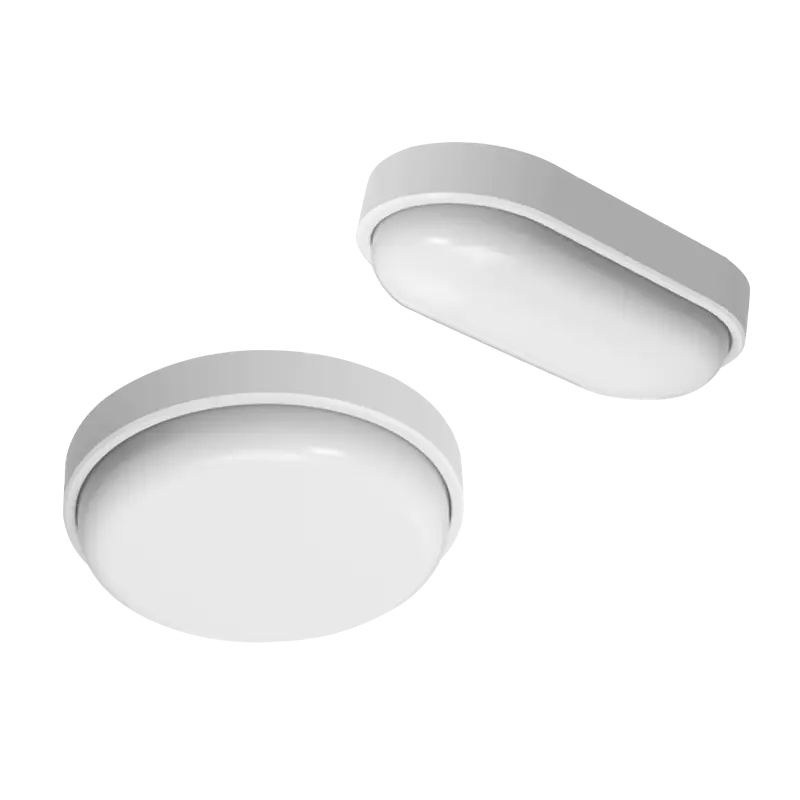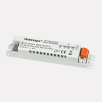


An IP65 marking on a tri-proof light is the printed result of two independent tests defined in IEC 60529: a dust test that produces the first digit and a water jet test that produces the second. Because the two results share one code, buyers often read IP65 as a single promise of "waterproof" and then install the fixture in a washdown bay, a car wash or a poultry house, where it can fail within a season. The rating is accurate; the interpretation is what goes wrong.
The first digit, 6, means dust-tight. Under the test, the enclosure is exposed to a dust-filled chamber with negative pressure inside the housing for up to eight hours, and no dust may enter. It also confirms full protection against contact with live parts. For a tri-proof light used in a foundry, a flour mill or a woodworking shop, this is the digit that matters most, because fine conductive or combustible dust destroys drivers long before water does.
The second digit, 5, means protected against water jets. The test uses a 6.3 mm nozzle delivering 12.5 litres per minute at roughly 30 kPa, aimed from 3 metres for at least 3 minutes, from every direction that the fixture can be installed in. Water may not reach harmful locations. That is a meaningful test, but the pressure is close to a garden hose with a thumb over the end. A pressure washer runs at 80 to 150 bar, which is 8,000 to 15,000 kPa, several hundred times higher. A fixture that passes IPX5 has never been tested against that.
The word "tri-proof" describes a three-part claim rather than a standard: proof against dust, proof against water, and proof against corrosion. Only the first two are covered by the IP code. The third is a materials and coating question that the buyer has to verify separately, which is why two luminaires with identical IP65 labels can behave very differently in a salt-air port terminal or an ammonia-rich poultry house.
| Rating | Dust protection | Water protection | Typical tri-proof use | What it does not cover |
|---|---|---|---|---|
| IP20 | No dust protection | None | Indoor office and retail ceilings | Any wet or dusty process area |
| IP44 | Objects larger than 1 mm | Splashing water | Covered walkways, light industrial bays | Jets, dust clouds, condensation |
| IP54 | Limited dust ingress | Splashing water | Warehouses with moderate dust | Fine dust, hose-down, corrosion |
| IP65 | Dust-tight | Low-pressure jets, 6.3 mm nozzle | Workshops, parking decks, cold stores | Immersion, pressure washing, steam, chemicals |
| IP66 | Dust-tight | Powerful jets, 12.5 mm nozzle at 100 kPa | Food plants, washdown corridors | High-pressure hot cleaning, solvents |
| IP67 | Dust-tight | Temporary immersion, 1 m for 30 minutes | Pit lighting, flood-prone basement areas | Continuous immersion, steam |
| IP69K | Dust-tight | 80 to 100 bar jets at 80 degrees Celsius | Open-hose food and beverage cleaning | Chemical attack, UV ageing, impact |
Two observations follow from the table. First, IP65 and IP66 have identical dust protection, so moving from one to the other buys water margin, not dust margin. Second, IP69K is not part of IEC 60529 at all; it comes from ISO 20653 and describes a specific high-pressure, high-temperature cleaning test. When a specification mixes IEC and ISO ratings in one sentence, ask for the test report behind each number, because the documents are different.
A gasket does not seal a luminaire; a sealing system does. In a typical tri-proof housing the system consists of three cooperating parts, and a weakness in any one of them makes the IP65 label a factory result rather than a field result.
Closed-cell silicone or EPDM cord, compressed 25 to 35 percent in a machined groove. Below 20 percent the material does not fill surface roughness; above 40 percent it takes a permanent set and stops recovering after thermal cycling. Compression set is measured under ISO 815 or ASTM D395, and a gasket that reads well on day one can leak at month eighteen if the set value is poor.
The diffuser is the largest unsupported surface on the fixture, and it moves under heat. Clips every 100 to 150 mm keep the edge seated; wider spacing lets the middle of the diffuser bow outward and lift the seal at the ends. Stainless spring clips outperform moulded-in plastic tabs, which fatigue and crack after a few hundred heat cycles.
The gland must match the cable outside diameter, be tightened to a stated torque and sit on a flat sealing washer. A breather membrane equalises pressure so that the housing does not pump air through the weakest seal each time the LED board heats and cools. Without a vent, a well-sealed fixture can draw in moist air and deposit it on the driver as condensation.
Material choice follows the environment rather than the price list. Silicone keeps its elasticity from about minus 50 to plus 200 degrees Celsius and suits cold stores and high-ambient plants, but it has limited resistance to some oils. EPDM handles water, steam and many detergents well, yet swells in mineral oils and aromatic solvents. Neoprene is a reasonable middle ground for general workshop use. None of these materials is universally correct, which is why a gasket specification without a material grade is only half a specification.
The quickest way to overpay or under-specify is to compare IP numbers without comparing the cleaning process behind them. A maintenance team that hoses a filling line with a 100 bar lance at 80 degrees Celsius is not performing an IPX5 test, and a fixture chosen on an IP65 datasheet will take water through the end caps within a few cleaning cycles.
In practice, three cleaning profiles cover most industrial lighting decisions. Dry brushing and occasional wiping need IP54 at most, provided the dust is coarse. Periodic hose-down with a low-pressure nozzle needs IP65 plus a corrosion-resistant coating. Open-hose cleaning with hot water and foam needs IP66 or IP69K, stainless hardware, a sloped housing that sheds water and a drain path that does not trap it. Specifying IP69K for a dry warehouse adds cost without adding protection, and specifying IP65 for a washdown corridor saves money for about eleven months.
The third proof in a tri-proof light is corrosion resistance, and it is rarely quantified. Two fixtures can share an IP65 label while one survives five years in a coastal water treatment plant and the other shows rust streaks on its clips within a single rainy season. The difference sits in the coating thickness, the alloy, the fastener grade and the polymer compatibility.
Die-cast aluminium with a polyester powder coat of 60 to 80 micrometres is the common industrial baseline. Salt spray results of 500 hours under ASTM B117 suit general outdoor use; 1,000 hours or more suits coastal and marine sites. Coating thickness is measurable on incoming goods with an inexpensive gauge, and it is one of the fastest supplier checks available.
Polycarbonate is tough, dimensionally stable and resistant to weak acids, but strong alkalis, ammonia and many aromatic solvents attack it and can cause stress crazing. Acrylic offers better UV clarity and hardness yet is more brittle and sensitive to ketones and chlorinated solvents. In food plants, the cleaning chemical often decides the polymer, not the light output.
Powder-coated steel clips rust first. Zinc-plated steel is acceptable indoors; 304 stainless handles most washdown areas; 316 stainless is the minimum for chlorides, salt fog and coastal air. Ammonia in poultry houses, hydrogen sulphide in wastewater plants and lactic acid in dairies each require a different review of gasket, coating and fastener together.
A practical rule for specification: ask for the coating system and dry film thickness, the stainless grade of every external fastener, the gasket elastomer grade and a chemical compatibility statement for the cleaning agents actually used on site. If a supplier cannot answer those four items, the IP65 label describes a laboratory result rather than a service life.
Field returns rarely show a failed gasket material. They show a gasket that was never compressed correctly, a gland left loose, or a knockout that was removed and never plugged. The sealed structural design of a tri-proof housing therefore matters more than the headline rating on the box.
Each of these is a process failure rather than a design failure, and each is preventable with an incoming inspection checklist and an installation instruction sheet that fits on one page. When a project suffers repeated ingress, comparing the failure pattern against this list usually identifies the cause faster than a laboratory test.
A sealed luminaire is thermally harder to design than an open one, and the driver pays the price. Inside an IP65 housing the driver compartment can run 10 to 15 degrees Celsius above room temperature, so a driver rated for 60 degrees Celsius case temperature may be operating at its limit in a 40 degree plant. That is why the ambient rating, the driver case temperature and the lumen derating curve belong on the same datasheet page.
The number that matters commercially is not the peak lumen output at 25 degrees but the maintained output at the real ceiling temperature. A fixture that publishes 140 lumens per watt at 25 degrees and delivers 118 at 50 degrees is doing honest engineering; a fixture that publishes the first number only is inviting a lighting design that will be under-lit in summer. Ask for the derating table, then compare fixtures at the ambient the plant actually reaches in July.
With more than a hundred housing, driver and diffuser combinations in a typical tri-proof light range, the fastest way to narrow the choice is to start from the room rather than from the wattage. The table below links common environments to an ingress target, a housing material and the driver features that experience shows are worth paying for.
| Environment | Ingress target | Housing and hardware | Driver features |
|---|---|---|---|
| General workshop, dry dust | IP65, IK08 | Powder-coated aluminium, PC diffuser | 2 kV surge, 0-10 V optional |
| Parking deck, coastal city | IP65, IK08 | Coated aluminium, 304 stainless clips | 4 kV surge, low flicker |
| Cold store, minus 25 degrees | IP65 | Cold-grade gasket, anti-condensation vent | Driver rated for low temperature start |
| Food processing, hose-down | IP66 or IP69K | 316 stainless clips, sloped housing, PMMA or PC | Sealed driver, 4 to 6 kV surge |
| Poultry or livestock house | IP65 plus ammonia-resistant seal | Coated aluminium, silicone gasket, 316 hardware | Corrosion-protected board coating |
| Car wash and tunnel | IP66 minimum, IP69K preferred | Stainless or thick-coated body, drain path | 6 kV surge, sealed connectors |
| Chemical plant, vapour present | IP65 plus chemical review | Polymer compatibility check per cleaning agent | External driver where possible |
Translating the table into a real order usually takes three specifications, not one. A workshop that runs a dry process and an occasional hose-down can often standardise on one IP65 package, while a food plant with two cleaning regimes will need two products and a clear zone map on the wall so that maintenance does not swap them.
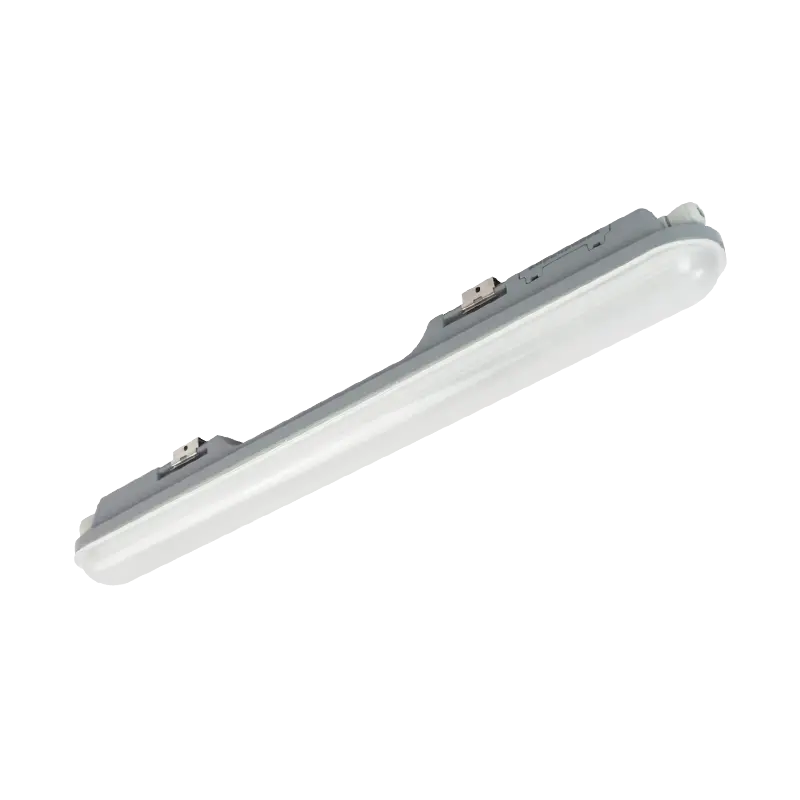
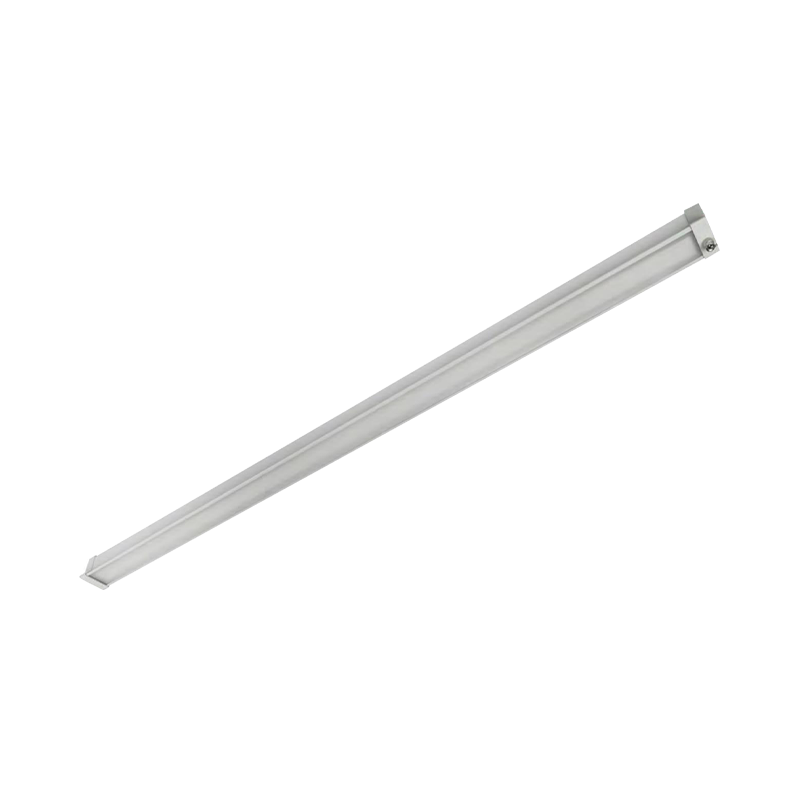
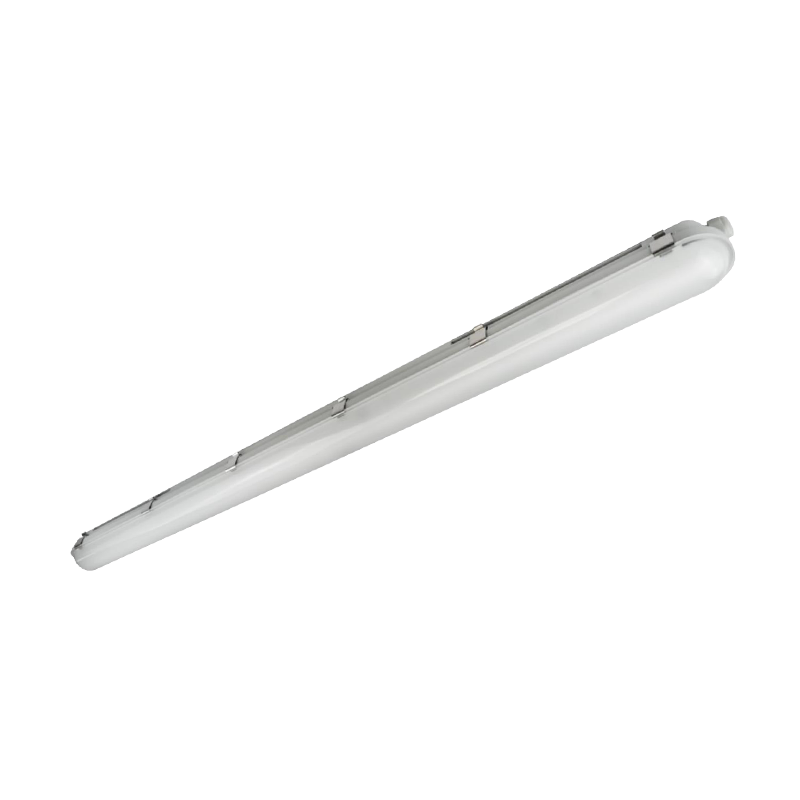
 LG06J Aluminium Alloy LED Tri-Proof LightIP65 aluminium tri-proof fixture with six wattage and size options, 120° beam and multiple CCTs; suits linear process bays needing a durable thermal path.View Product →
The aluminium alloy body and 120 degree beam angle of the LG06J suit linear process bays where light has to reach both the work surface and the vertical faces of equipment. An aluminium housing also gives the thermal path that a sealed polycarbonate body cannot match at higher wattages, which matters when the ambient rating is the limiting factor rather than the lumen package.
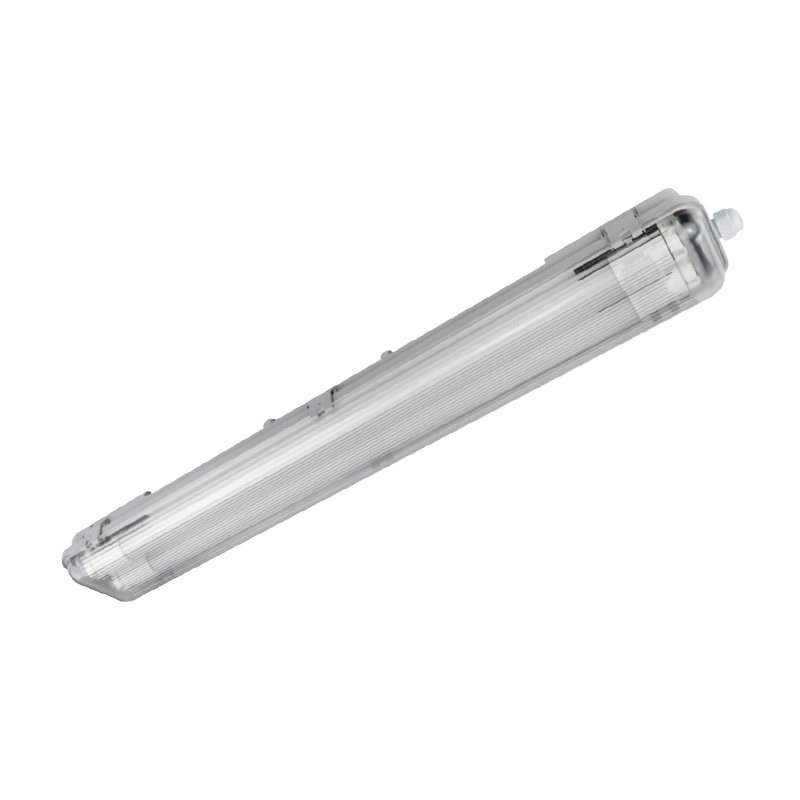
LG07O T8 LED Tube Tri-Proof LightIP65 T8 tube tri-proof light with single- and double-tube models and 9W–24W options; suited to workshops retaining T8 maintenance and mounting practice.View Product →
For workshops that already run T8 fixtures on a maintenance route, a tube-format tri-proof light keeps spares and installation practice unchanged while adding the seal. The LG07O is defined as a workshop-specific, low-energy T8 tube tri-proof light, which is a sensible fit where the ceiling grid is fixed and the goal is to replace fluorescent tubes without rebuilding the mounting rail.
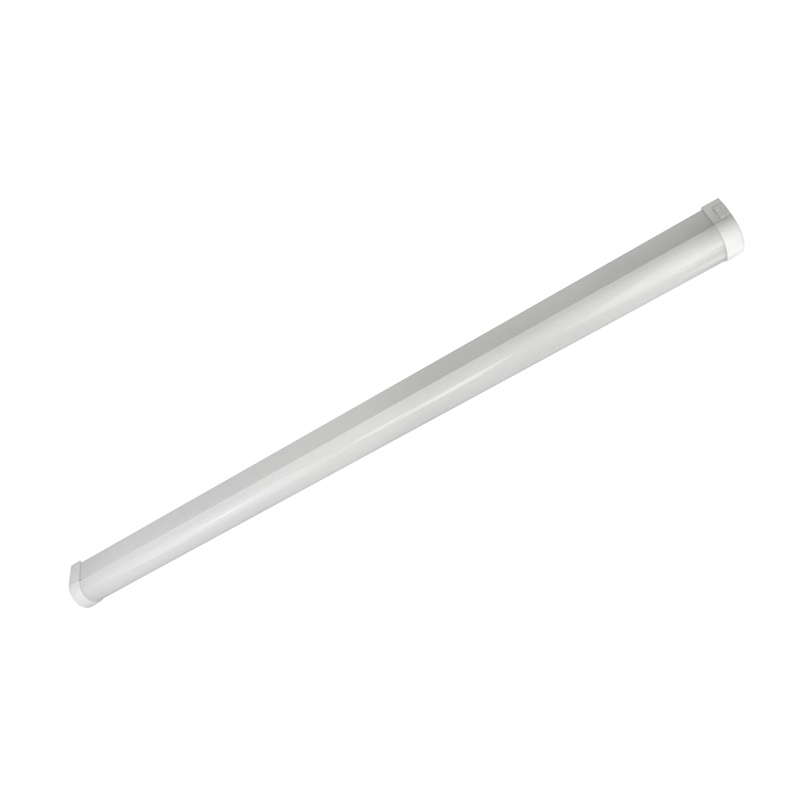
LG21C High-Brightness LED Tri-Proof LightNorth American tri-proof fixture with AC120–277V input, 150W–250W options and 150 lm/W output; suits wet-grade new construction and mixed ceiling layouts.View Product →
Projects specifying to North American practice need fixtures designed around that market's voltage, mounting and certification expectations rather than adapters bolted onto a European body. The LG21C sits in a dedicated North American vapor-tight and tri-proof family, alongside shop lights and backlit panels, which simplifies a mixed ceiling where the same project needs linear, panel and sealed fixtures.
Three practical questions separate these options faster than a photometric comparison. Does the ceiling grid allow a linear body, or does the fixture have to replace a tube on an existing rail? Is the cleaning regime dry, damp or open-hose? And does the site standardise on 0 to 10 V, DALI or simple on-off switching? Answers to those three usually eliminate all but one housing family before the first lumen calculation.
Most ingress claims are decided on site, in the twenty minutes an electrician spends per fixture. A few habits make the difference between a five-year seal and a two-year leak.
Purchase price is roughly a fifth of the lifetime cost of an industrial lighting fixture when labour, access equipment and downtime are counted. The comparison below uses a 25-fixture workshop running 5,000 hours a year at an electricity price of 0.12 per kilowatt hour, and it is deliberately conservative on maintenance.
| Item | Fluorescent batten, 2 x 36 W | LED tri-proof, 40 W |
|---|---|---|
| Circuit power per fixture | About 85 W including ballast losses | About 40 W |
| Annual energy, 25 fixtures | About 10,600 kWh | About 5,000 kWh |
| Annual energy cost | About 1,270 | About 600 |
| Lamp replacement cycle | 12 to 18 months | None planned within 50,000 hours |
| Cleaning and resealing | Gasket and diffuser removed for relamping | Wipe-down only in most plants |
| Access equipment per intervention | Recurring, often the largest hidden cost | Reduced to commissioning and inspection |
The saving that rarely appears in a payback calculation is the cost of a failed seal. Water inside a fluorescent batten destroys the ballast and often the connector; water inside an LED fixture destroys the driver, which may be sealed into the housing and not replaceable on site. Choosing a fixture with a replaceable driver and a documented gasket part number turns a catastrophic failure into a fifteen-minute repair, and that is worth more than a few percent on the purchase order.
A supplier's IP65 statement should be traceable to a test report, a sample and a spare-part list. The following sequence catches most of the problems that a catalogue cannot show.
Suppliers with a witnessed laboratory and a documented sealing design answer these questions in a single email. Suppliers who answer with adjectives rather than documents are telling you something useful about how the fixture was validated.
No. IP65 means dust-tight and protected against low-pressure water jets from any direction. It does not permit immersion, and it is not tested against pressure washing, steam or long-term exposure to standing water. A fixture installed where water collects on the housing is outside the scope of the rating, regardless of the label.
IP65 is a measured ingress rating. Tri-proof is a product category that usually combines dust protection, water protection and corrosion resistance. Every tri-proof light should carry an IP rating, but an IP65 light is not automatically corrosion-resistant, and the third proof has to be verified from the coating, alloy and fastener specification.
Yes, under a canopy or in a sheltered position where rain does not drive directly into the cable entries, and provided the housing is UV-stabilised and the hardware is corrosion-rated. Exposed coastal installations usually need 316 stainless clips, a thicker powder coat and a higher water rating than IP65 alone.
IP66 is stronger against water jets but identical against dust. The choice depends on the cleaning method: a 12.5 mm nozzle at 100 kPa, used in IPX6 testing, is closer to real washdown practice than the 6.3 mm nozzle of IPX5. If the site never uses a hose, the extra margin buys nothing.
They can, and often do. Thermal cycling pulls moist air through the weakest seal and deposits water on the driver when the fixture cools. A breather membrane that equalises pressure without allowing liquid water through is the standard countermeasure, together with a design that keeps the driver away from the coldest surface.
Most industrial LED tri-proof fixtures are rated for 50,000 hours to L70 or L80, which is roughly ten years at 5,000 hours per year. The gasket, driver and coating often determine real service life before the LEDs do, which is why spare-part availability matters as much as the lumen maintenance figure.
Not directly, but the sealing and thermal design required to achieve it usually constrains the thermal path. A well-designed IP66 fixture can still deliver high efficacy; a poorly designed one loses output as the ambient rises. Compare fixtures at the same ambient temperature and the difference becomes visible.
It depends on the cleaning chemicals. Polycarbonate is tough but sensitive to strong alkalis and ammonia; acrylic offers better clarity and UV stability but is more brittle and attacked by ketones. Stainless hardware, a sloped housing that sheds water and a documented cleaning-agent compatibility list matter more than the polymer name alone.
Often yes, if the mounting centres, supply voltage and cable entry match. Tube-format tri-proof lights are designed for exactly this replacement, keeping the existing rail and ceiling grid. Check the driver position, the overall depth and the gland orientation before ordering, because a deeper body can foul a ceiling tile or a pipe run.
Keep the IP test report, the driver datasheet, the gasket material certificate, the coating thickness record and the installation torque sheet with the as-built drawings. When a leak appears three years later, those documents show whether the fixture failed or the installation did, and that distinction decides who pays for the repair.



No.8, Ankang West Road, Zonghan Street, Cixi City, Zhejiang Province, P.R.China
0086-574-6320 0283
Copyright © Ningbo Longer Lighting Co., Ltd.
All Rights Reserved.
 Wholesale LED Lighting Fixtures Manufacturers

 Deutsch