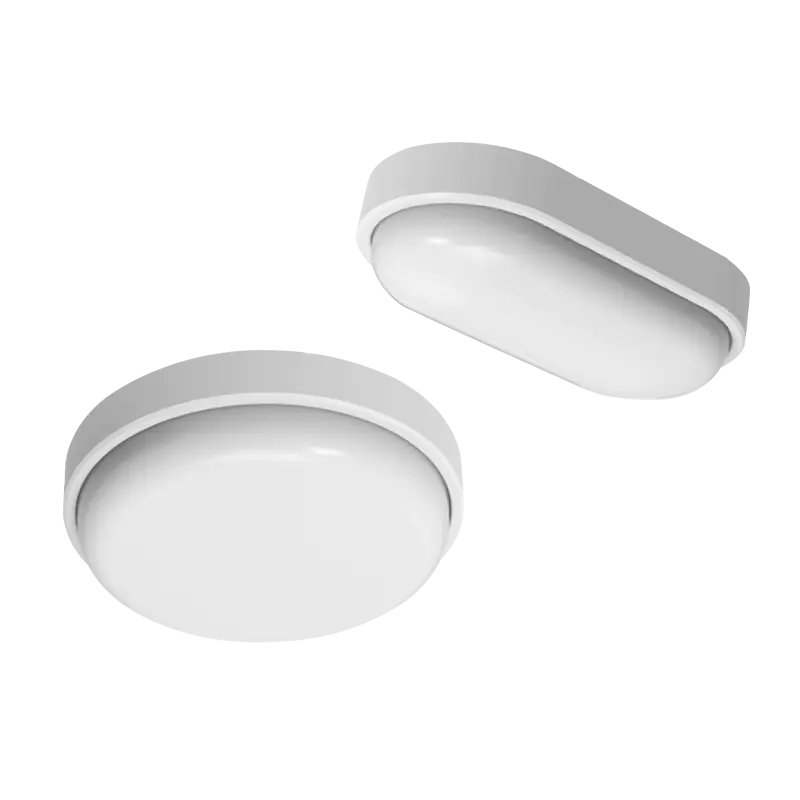


Installing an LED Ceiling Light is not as simple as just "buying a lamp and hanging it up." To achieve the ideal lighting effect, several core principles of interior design must be followed:
The simplest formula for choosing the fixture size is: Add the length and width of the room (in feet), and the resulting number is the ideal diameter of the fixture (in inches).
Example: If a room is 10 feet wide and 12 feet long, 10 + 12 = 22. You should look for an LED Ceiling Light with a diameter of approximately 22 inches (about 56 cm).
Hallways and Living Rooms: The bottom of the fixture should be no lower than 7 feet (about 2.1 meters) from the floor to ensure people can pass through without obstruction or feeling cramped.
Dining Rooms: If installing a pendant-style LED Ceiling Light over a dining table, the bottom of the fixture should be 30 to 36 inches (about 76 to 91 cm) from the tabletop.
Do not rely on a single LED Ceiling Light to illuminate the entire space. The ideal scheme includes:
Ambient Lighting: Provided by the main ceiling light for background illumination.
Task Lighting: Enhanced brightness over desks or kitchen/bathroom counters.
Accent Lighting: Using spotlights to highlight artwork or wall textures.
When purchasing, comparing the parameter table is essential. Below are the standard requirements for an LED Ceiling Light in different spaces:
| Space Type | Recommended Color Temp (K) | Recommended CRI | Light Atmosphere |
| Bedroom / Lounge | 2700K - 3000K | 80+ | Warm, relaxing, quiet |
| Living Room / Study | 4000K - 4500K | 90+ | Natural, bright, realistic |
| Kitchen / Bathroom | 5000K - 6000K | 90+ | Clean, focused, no color distortion |
Although the technology is very mature, the LED Ceiling Light is not perfect. Before deciding on a full replacement, you need to understand the following drawbacks:
Many modern LED Ceiling Lights feature an integrated design where the LED chips are soldered directly to the circuit board. This means:
If a single chip or the driver fails, it usually cannot be fixed by simply replacing a "bulb" like in old-fashioned fixtures; often, the entire fixture must be replaced.
This is one of the most common complaints. If you use an old phase-cut dimmer switch (designed for incandescent bulbs) with a new LED Ceiling Light, you may experience:
Flicker: Especially at low brightness settings.
Humming: Noise generated by electronic interference.
Limited Dimming Range: It may only adjust from 30% to 100% brightness, failing to reach ultra-low levels.
Some low-cost LED Ceiling Lights rely heavily on the blue spectrum to increase perceived brightness. Long-term exposure to high-intensity cool white light can suppress melatonin secretion, affecting sleep quality and causing significant eye strain.
While LEDs are not hot to the touch like incandescent bulbs, their electronic components are extremely sensitive to heat. If the heat sink of the LED Ceiling Light is poorly designed or installed in a fully enclosed space with poor ventilation, the chip's lifespan can plummet from a claimed 50,000 hours to less than 10,000 hours.
Replacing an old fluorescent or incandescent fixture with an LED Ceiling Light is a DIY task that can be done yourself, but safety is always the priority.
Tools: Non-contact voltage tester, wire strippers, Phillips/flat-head screwdrivers, stepladder.
Core Safety: Turn off the circuit breaker for that area at the distribution box, not just the wall switch.
Remove the lamp cover and use a voltage tester to confirm there is no current in the junction box.
Unscrew the mounting screws and gently lower the old fixture.
Disconnect the wire connectors (usually black and white wires).
Most LED Ceiling Lights come with a specific mounting bracket. Align it with the holes in the ceiling junction box and secure it firmly with screws. Ensure the bracket is level, otherwise the installed fixture will be crooked.
Follow standard color codes (note: these may vary by country/region; the following is a general standard):
Black or Brown (Live): Connect to the live input of the LED driver.
White or Blue (Neutral): Connect to the neutral input of the LED driver.
Green or Bare Copper (Ground): Must be connected to the ground screw on the bracket or junction box.
Push the driver and excess wires into the junction box. Snap or screw the LED Ceiling Light onto the bracket. Finally, restore power and test the switch. If the light supports a CCT (Color Temperature) switch, adjust it to your preferred color before final assembly.
Even high-quality LED Ceiling Lights can encounter technical failures during use:
Phenomenon: The switch is off, but the LED chips still emit a faint glow.
Cause: Usually because the switch is cutting the neutral wire instead of the live wire, or there is a small induced current in the circuit.
Solution: Check the switch wiring to ensure it is on the live circuit loop.
Phenomenon: After some use, the originally pure white light turns yellowish or purplish.
Cause: The phosphor coating encapsulating the LED deteriorates due to heat. This is usually caused by poor heat sink design or continuous high-power operation.
Phenomenon: The fixture does not light up at all, or it flashes rhythmically and intermittently.
Cause: 90% of LED Ceiling Light failures are not from the LED chips themselves but from damaged capacitors in the driver. High-frequency fluctuations or inferior capacitors are the primary causes.
A: Yes, this is known as a "Retrofit." However, pay attention to the socket's wattage limit (though LED wattage is usually very low) and heat dissipation space. If the old fixture is fully enclosed, it is recommended to use LED bulbs specifically labeled "for use in enclosed fixtures."
A: "50,000 hours" refers to the decay time of the LED chip under ideal laboratory conditions. In reality, ambient temperature, current shocks from frequent switching, and the quality of the driver circuit determine the lifespan. Buying an LED Ceiling Light with a good heat dissipation structure (metal base is superior to plastic) is key.
A: Some low-end drivers output unstable current, causing the light to flicker at a high frequency invisible to the naked eye. This can lead to eye fatigue, migraines, and even vision impact. To test: aim your phone camera at the light; if moving black bars appear on the screen, the fixture has severe flicker.
A: These types of LED Ceiling Lights have both cool white and warm yellow LED chips arranged inside. By toggling the switch, the driver supplies power to different proportions of chips. For example: Cool white on + Warm yellow off = 6000K; both on = 4000K.



No.8, Ankang West Road, Zonghan Street, Cixi City, Zhejiang Province, P.R.China
0086-574-6320 0283
Copyright © Ningbo Longer Lighting Co., Ltd.
All Rights Reserved.
 Wholesale LED Lighting Fixtures Manufacturers

 Deutsch